
Full Story
Watch an experienced Sri Lankan tracker for a morning and you notice something odd. A lot of the time the jeep is not moving at all. The engine is off, the driver is leaning out of the window, and everyone is listening. Then a spotted deer barks somewhere to the left, a langur starts calling from a tree, and the jeep is suddenly off in that direction.
Finding a leopard is mostly about reading signs. Once you know what they are, safaris become much more interesting, because you are part of the search instead of just waiting to be shown something.
Listen first: alarm calls
A leopard moving through the scrub is rarely seen first. It is heard about, second-hand, from the animals that spot it.
- Spotted deer give a sharp, repeated bark when they see a predator, and often stand staring in one direction with their tails raised.
- Grey langurs make a loud, coughing call from the trees. Because they sit high up, they often see a cat long before anything on the ground does.
- Peafowl make a loud honking alarm, quite different from their usual cry.
- Sambar deer give a deep, single honk, which can be a sign of a cat or a sloth bear.
- Jungle fowl and babblers chatter and scold when something dangerous is on the ground nearby.
One call means little. Several calls from different species in the same area, especially if they are moving, are a strong clue that a leopard is walking.
Look down: tracks and signs
Yala's sandy tracks and Wilpattu's pale sand are perfect for reading tracks. Trackers check them constantly, especially first thing in the morning.
- Pugmarks: A leopard print is round, with four toe pads and no claw marks, because the claws are retracted when walking. Sharp edges and no other tracks on top mean it is fresh.
- Direction: Following which way the prints point tells the tracker which side of the road the cat went into.
- Scrapes and scent marks: Leopards scrape the ground and spray bushes to mark territory, often at the same spots along the track.
- Drag marks and kills: A kill hauled into a tree means the leopard will usually stay nearby for a day or two, which is why news of a kill spreads quickly among drivers.
Look up and out: where leopards rest
Leopards are creatures of habit. Individual cats have favourite spots, and a good tracker knows them.
- Rock outcrops: In Yala, leopards love lying on the big granite rocks, especially in the early morning and late afternoon. Scan the tops and the shady ledges.
- Trees: On hot days, a leopard may lie along a thick branch. Look for a hanging tail, which is often easier to spot than the body.
- Waterholes and villus: In the dry season, cats come to drink, often at dawn or dusk. In Wilpattu, the edges of the lakes are prime spots.
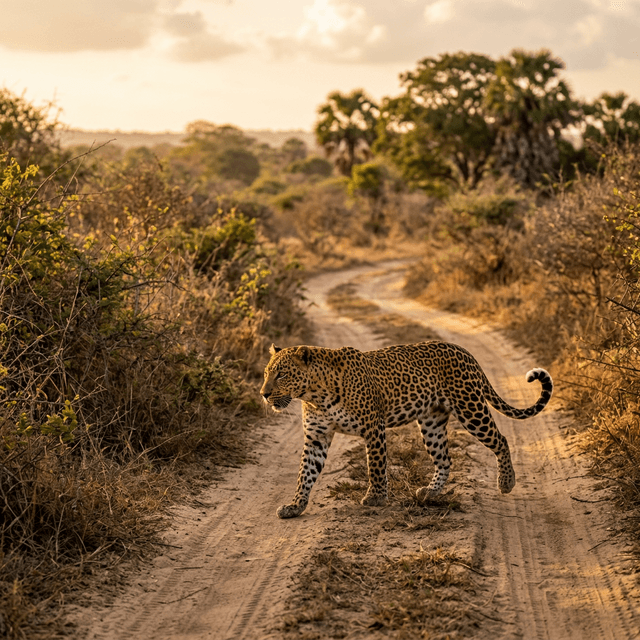
- Track edges: Leopards like walking along roads because it is easier and quieter than pushing through scrub. Many sightings are of a cat simply strolling down the track ahead.
Read the time of day
Leopards are most active at dawn and dusk and tend to rest in shade through the heat. That shapes the search:
- First light: Fresh tracks, cats still on the move, and sometimes a leopard on a kill.
- Mid-morning to mid-afternoon: Check trees, deep shade and known resting spots. Movement is rare.
- Late afternoon: Cats wake, stretch, and often come out onto rocks or into the open before setting off for the night.
Our guide to the best time for a leopard safari covers the seasonal side of this.
How to scan like a tracker
Most people look at the middle distance in front of the jeep. Trackers do something different.
- Scan slowly in sections rather than sweeping your eyes across the whole view.
- Look for shapes that do not fit: a horizontal line in vertical scrub, a rounded shape on a straight branch, or a pair of ears above long grass.
- Look for colour rather than spots. At a distance, a leopard is a warm golden patch against grey rock or green bush.
- Use binoculars on anything odd. Most "leopards" turn out to be logs, but the one that does not is worth it.
- Check behind you. Leopards often cross the track after a jeep has passed.
What you can do to help
- Stay quiet. Talking makes it harder to hear alarm calls and can push cats away.
- Ask the driver to stop now and then and switch off the engine.
- Tell your tracker you are happy to wait at a promising spot rather than drive around fast.
- Bring your own binoculars so everyone in the jeep can scan at once.
When you find one
The moment of finding a leopard is exciting, but it is also when people most often get it wrong. Keep your voice down, do not stand up suddenly and do not ask the driver to move closer once the cat is visible. Give it space to keep doing what it was doing, whether that is resting, walking or hunting. If more jeeps arrive and the scene becomes crowded, it is usually kinder, and often more rewarding, to move on. Our safari etiquette guide has more on this.
If you get a good photo, apps like LeopardID can sometimes tell you which individual Yala leopard you saw, based on its unique spot pattern.